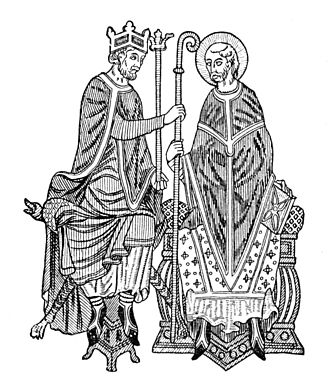
"The second half of the eleventh century was a particularly decisive time in the history of the church. To mention only three of the more important developments, the popes emerged as the leaders of an international reform movement in western Europe; they became involved in a dispute with the empire whose effects were to be long-lasting; and they directed the military efforts of Christendom against Islam, most notably in the First Crusade
900 Years Council of Nablus, January 16, 1120 - synod, parliament and Templar kick-off
Very soon after the First Crusade, European troops began to return to their homelands, having fulfilled their promise to liberate the Holy Land. This put extra strain on the remainders, who faced continued challenges ranging from locusts plagues to repeated Saracen incursions.
To face up to these challenges, the Council of Nablus was convened. This council of ecclesiastic and secular lords of the crusader Kingdom of Jerusalem was held on January 16, 1120. It was convened by Warmund, Patriarch of Jerusalem, and King Baldwin II of Jerusalem.
The council established twenty-five canons (decrees) dealing with both religious and secular affairs. As such it provided the first written laws for the kingdom. Therefore it can be considered both a parliament and an ecclesiastical synod.
The Nablus Council was probably also where Hugues de Payens obtained permission from King Baldwin II of Jerusalem and Warmund, Patriarch of Jerusalem to found the Knights Templar. But direct reference to the Templars as such or their recognition as a group is missing in the decrees. There is only mention that "Achardus, prior of the Temple of the Lord", was present. This probably pertains to Achardus de Aroasia, "prior Templi Domini" (Vita S. Joh., episcopus Morinorum; AA.SS.: in the 12th century, January 27).
Another source mentions: "Pauperes commilitones Christi Templique Salomonici, later known as the Knights Templar.
The full text of the Nablus Canons, of which at present only one copy remains in the Vatican Library (MS Vat. Lat. 1345), is quoted below (source):
Here begins the Council of Nablus
In the 1120th year of the Incarnation of the Lord - after, as our sins demand, the country of Jerusalem was devastated by many calamities and for four years it was laid waste, with its crops consumed by locusts and its walls by frequent Saracen assaults and plots, and with so many of its pilgrims and citizens murdered - a man of dove-like innocence and a pupil of humility, the patriarch Warmund, and a son of good fortune, Baldwin, the second King of the Latins of Jerusalem, readying to meet the danger threatening the citizens with prayers of piety and works of justice, prodded by Divine Inspiration to raise up the Church and fix firm the country, entered into counsel with the prelates of the Church and the leading men of the kingdom in the second year of his reign and of his patriarchate, on the 17th Kalends of February [January 16], at the city of Nablus of Samaria. And, as the need of the land demanded, for the correction of the fallen people, they established the decrees which we have written below.
To face up to these challenges, the Council of Nablus was convened. This council of ecclesiastic and secular lords of the crusader Kingdom of Jerusalem was held on January 16, 1120. It was convened by Warmund, Patriarch of Jerusalem, and King Baldwin II of Jerusalem.
The council established twenty-five canons (decrees) dealing with both religious and secular affairs. As such it provided the first written laws for the kingdom. Therefore it can be considered both a parliament and an ecclesiastical synod.
The Nablus Council was probably also where Hugues de Payens obtained permission from King Baldwin II of Jerusalem and Warmund, Patriarch of Jerusalem to found the Knights Templar. But direct reference to the Templars as such or their recognition as a group is missing in the decrees. There is only mention that "Achardus, prior of the Temple of the Lord", was present. This probably pertains to Achardus de Aroasia, "prior Templi Domini" (Vita S. Joh., episcopus Morinorum; AA.SS.: in the 12th century, January 27).
Another source mentions: "Pauperes commilitones Christi Templique Salomonici, later known as the Knights Templar.
Here begins the Council of Nablus
In the 1120th year of the Incarnation of the Lord - after, as our sins demand, the country of Jerusalem was devastated by many calamities and for four years it was laid waste, with its crops consumed by locusts and its walls by frequent Saracen assaults and plots, and with so many of its pilgrims and citizens murdered - a man of dove-like innocence and a pupil of humility, the patriarch Warmund, and a son of good fortune, Baldwin, the second King of the Latins of Jerusalem, readying to meet the danger threatening the citizens with prayers of piety and works of justice, prodded by Divine Inspiration to raise up the Church and fix firm the country, entered into counsel with the prelates of the Church and the leading men of the kingdom in the second year of his reign and of his patriarchate, on the 17th Kalends of February [January 16], at the city of Nablus of Samaria. And, as the need of the land demanded, for the correction of the fallen people, they established the decrees which we have written below.
The Concept of Martyrdom in the Order of the Knights Templar
"Martyrdom in the Order of the Knights Templar must be understood as an extremely multilayered and versatile concept. It sometimes reveals itself openly, for example in the works of Bernard of Clairvaux or the carefully constructed stories of Templars suffering martyrdom prior to being received into heaven.
Subscribe to:
Posts (Atom)
