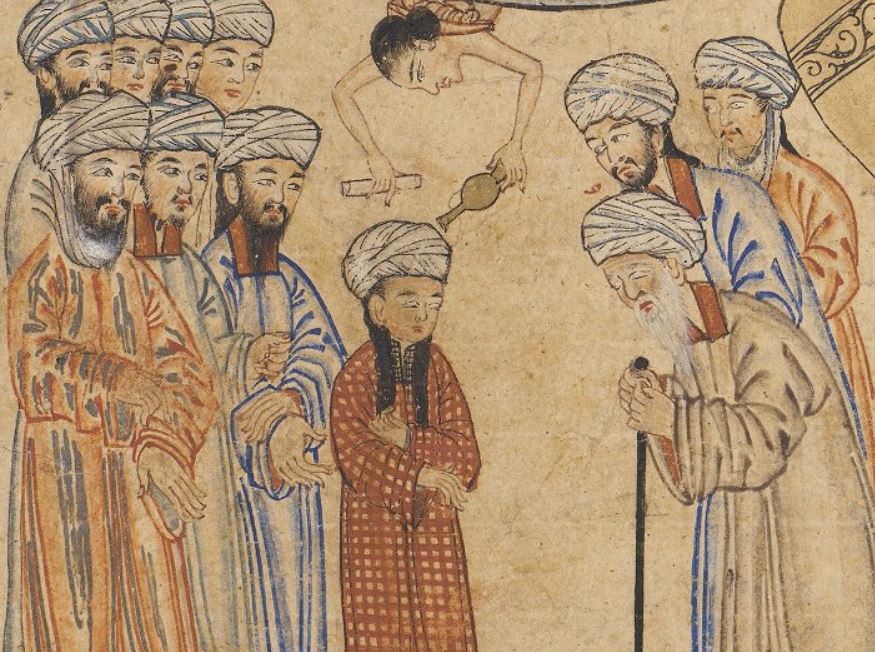
The Knights Templar in Arab sources of the 12th century
In the period 1118-1156, the Military Orders played a relatively minor role in the Holy Land. In fact, they are not well documented even in Latin sources. Among the Arabs their existence went completely unnoticed. In 1157 the rising importance of the Orders began to attract the attention of Muslim writers.
Lessons in Crusader cuisine
The natural harbor at Apollonia Fortress in Israel never developed into a port as large as Acre, where dozens of ships would anchor in the 13th century, to be loaded with locally- produced sugar bound for Europe. But the ruins of Apollonia are enough to make one see that the constant movement of people, raw materials and cooking techniques was already occurring hundreds of years before the word “globalization” became part of the modern vocabulary. Muslim protection of Christian monasticism before the Crusades
Although pre-Islamic arabia is often viewed, with some justification, as somewhat of a cultural backwater, the Arabs nonetheless had extensive contacts with both the Sassanid Persian and Byzantine empires.
Counts of (West Frisian) Holland, the cursades and the Templars
Proof seems to be missing of participation from Holland in de Crusades. This appears to be false.
Until about 1300 the former county Holland was still calles 'Frisia'. The name Holland dates back to 1101, and even then it was a limited area only. The counts of Holland were called the counts of West Friesland. About Frisians who participated in the Crusades, sufficient information is to be found in the sources.
Saint Francis of Assisi, early missionary to the Muslim world
Saint Francis of Assisi, founder of the Franciscan Order, was born at Assisi in Umbria, in 1181 or 1182. He died there on 3 October, 1226. Many of the stories that surround the life of St. Francis say that he had a great love for animals and the environment. Therefore October 4, Saint Francis' feast day, is celebrated as World Animal Day.
Less known is that Francis visited Egypt and attempted rapprochement with the Muslim world, be it in the way of a missionary.
Templar Houses and local society in Britain
"This article has set out a small selection of the evidence surviving in the records of the ‘Templar’s affair’ in the British Isles that may deepen scholars’ knowledge of the Templars’ relations with society at large.
It appears that at least some Templar houses were integrated into their locality, with travellers passing through the house on a regular basis, lodging there or visiting the chapel. Many local people were employed by a Templar commandery, on a full-time basis all year round or on a part-time seasonal basis. In addition, through the provision of corrodies and charitable giving, a Templar house could be a significant local provider of care to the elderly or needy. The evidence set out here indicates that the level of provision varied from house to house, and that some houses were more significant to their locality than others.
However, as this article has barely scratched the surface of the surviving evidence, there is great potential for further research in this area(....) The documents relating to the investigations into the Templars in the British Isles between 1308 and 1312 contain many examples of contact between the brothers and their local communities which, taken together, suggest that the relationship between the order’s houses and their localities could be close, even though this relationship might infringe the letter of the order’s privileges and regulations."
This blog quotes from the text of the paper "Relations between Houses of the Order of the Temple in Britain and their local communities" by Helen J. Nicholson published in Knighthoods of Christ: Essays on the History of the Crusades and the Knights Templar Presented to Malcolm Barber, ed. Norman Housley (Aldershot etc.: Ashgate, 2007), pp. 195-207. Published article Copyright © 2007; this edition © 2015; Illustration adapted from this source
It appears that at least some Templar houses were integrated into their locality, with travellers passing through the house on a regular basis, lodging there or visiting the chapel. Many local people were employed by a Templar commandery, on a full-time basis all year round or on a part-time seasonal basis. In addition, through the provision of corrodies and charitable giving, a Templar house could be a significant local provider of care to the elderly or needy. The evidence set out here indicates that the level of provision varied from house to house, and that some houses were more significant to their locality than others.
However, as this article has barely scratched the surface of the surviving evidence, there is great potential for further research in this area(....) The documents relating to the investigations into the Templars in the British Isles between 1308 and 1312 contain many examples of contact between the brothers and their local communities which, taken together, suggest that the relationship between the order’s houses and their localities could be close, even though this relationship might infringe the letter of the order’s privileges and regulations."
This blog quotes from the text of the paper "Relations between Houses of the Order of the Temple in Britain and their local communities" by Helen J. Nicholson published in Knighthoods of Christ: Essays on the History of the Crusades and the Knights Templar Presented to Malcolm Barber, ed. Norman Housley (Aldershot etc.: Ashgate, 2007), pp. 195-207. Published article Copyright © 2007; this edition © 2015; Illustration adapted from this source
Support TemplarsNow™ by becoming a Patron, tipping us or buying one of our Reliable Books
Eastern influence in pre-crusade southern France
Southern France has, long before the start of the Crusades at the end of the 11th Century, been a gateway to the Orient.
"Just warfare" and the rise of the military religious orders in the 12th century
"In an ideological sense, the growth of the military orders was fostered by a theological shift in attitude of the Church towards just warfare. Prior to the First Crusade, the Peace of God movement had developed a policy within the Church that knights should be restricted from fighting among themselves and instead put their energies into fighting for the Church. Prior to this, the knightly class had been in almost a constant state of civil war amongst themselves and with the Church.
At the Council of Clermont in 1095, Pope Urban II advocated for the service of secular knights for the church by declaring that “you have promised more firmly than ever to keep the peace among yourselves and to preserve the rights of the church, there remains still an important work for you to do.” By deliberately trying to encourage secular knights to fight for God in the Crusades, the Church created an acceptable form of warfare within Christian ideology.
While Urban was not encouraging monks to go on Crusade, the military orders could not have existed without the ideology behind his speech because of Christianity’s traditional pacifism. The key element to this new ideology was the idea of miles Christi. The term miles Christi was essential to the ideology of the military orders and is critical in understanding their rise to power. Coming into use through the writings of St Augustine and literally meaning “soldier of Christ,” it reflects the duty of a Christian knight to protect Christendom from outside evils. As the monk fought the spiritual enemies of the Church from within his monastery, the soldier of Christ fought Christianity’s physical enemies. Instead of committing the sin of murder, the traditional Christian view of warfare, a miles Christi was actually doing penance for his sins.
The Hospitallers and the Templars fought Islam in the Holy Land and the Teutonic Knight was hugely instrumental in fighting paganism in eastern Europe. The knights of the military orders were by definition miles Christi and their development and rise to power would not have been possible without the widespread acceptance of this idea.
To the Church, the military orders provided the perfect outlet for the knightly class even when there was no official crusade being promoted. Therefore, the Church was more than willing to support them and allow their power to grow both in the Holy Land and in Europe. As the dominant European ideology, the Church’s changing theology played a large role in the growth of the military orders, and was aided most directly by the theological support of St. Bernard."
This blog quotes form a publication based on a 2014 paper by Sarah E. Hayes in the Gettysburg Historical Journal, www.medievalists.net; Illustration Templar and Hospitaller Knights, source
At the Council of Clermont in 1095, Pope Urban II advocated for the service of secular knights for the church by declaring that “you have promised more firmly than ever to keep the peace among yourselves and to preserve the rights of the church, there remains still an important work for you to do.” By deliberately trying to encourage secular knights to fight for God in the Crusades, the Church created an acceptable form of warfare within Christian ideology.
While Urban was not encouraging monks to go on Crusade, the military orders could not have existed without the ideology behind his speech because of Christianity’s traditional pacifism. The key element to this new ideology was the idea of miles Christi. The term miles Christi was essential to the ideology of the military orders and is critical in understanding their rise to power. Coming into use through the writings of St Augustine and literally meaning “soldier of Christ,” it reflects the duty of a Christian knight to protect Christendom from outside evils. As the monk fought the spiritual enemies of the Church from within his monastery, the soldier of Christ fought Christianity’s physical enemies. Instead of committing the sin of murder, the traditional Christian view of warfare, a miles Christi was actually doing penance for his sins.
The Hospitallers and the Templars fought Islam in the Holy Land and the Teutonic Knight was hugely instrumental in fighting paganism in eastern Europe. The knights of the military orders were by definition miles Christi and their development and rise to power would not have been possible without the widespread acceptance of this idea.
To the Church, the military orders provided the perfect outlet for the knightly class even when there was no official crusade being promoted. Therefore, the Church was more than willing to support them and allow their power to grow both in the Holy Land and in Europe. As the dominant European ideology, the Church’s changing theology played a large role in the growth of the military orders, and was aided most directly by the theological support of St. Bernard."
This blog quotes form a publication based on a 2014 paper by Sarah E. Hayes in the Gettysburg Historical Journal, www.medievalists.net; Illustration Templar and Hospitaller Knights, source
Support TemplarsNow™ by becoming a Patron, tipping us or buying one of our Reliable Books
Subscribe to:
Posts (Atom)