
Showing posts with label clairvaux. Show all posts
Showing posts with label clairvaux. Show all posts
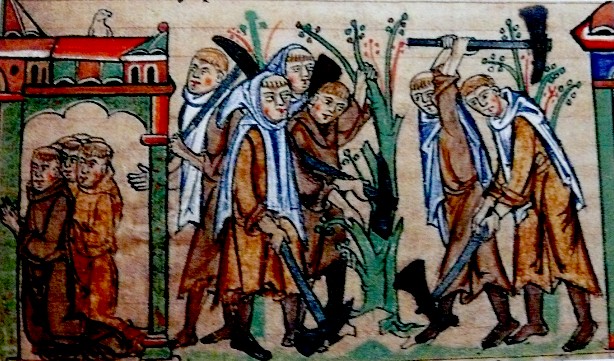
From Knights to Monks - How Secular Skills Helped Build the Cistercian Order

Abbot Bernard de Clairvaux - Asceticism, Ailment and Growth

Bernard de Clairvaux' youth - from squire to monk

Bernard de Clairvaux (1090/1091 - 1153), Cistercian abbot and theologian, is renowned for his sermons and letters that eloquently blend Christian mysticism with the ideals of knighthood. However, the first 21 years of his life (the years of legal minority) he lived as Bernard de la Fontaine the life of a member of the Burgundian nobility, being a squire himself in direct contact with knights. What is known of these early years?
Clairvaux Abbey - 910 years old

The relationship between Hugues de Payns and Bernard de Clairvaux

The Cistercian Order: incorporated instead of founded

Unlike what is generally thought, there was no Cistercian Order as a united entity for much of the twelfth Century. (...) Such a Cistercian Order was only invented in the third quarter of the twelfth century. That Order as we usually think of it, an administrative institution that united more than five hundred abbeys by 1215 (when its organization was held up by the Fourth Lateran Council as a model to be emulated), did not appear in 1119 or 1113 or 1098, the dates usually asserted, but much later.
Cistercian monasteries - preface to Knights Templar preceptories
Clairvaux Abbey - 900 years in 3D animation
 |
| Watch de video here |
The abbey of Clairvaux (today at the commune of Ville-sous-La-Ferté, in the Aube Department, France), the third daughter of the Cistercian abbey of Cîteaux, was founded in the summer of 1115 by Bernard de Fontaine, the later Saint Bernard of Clairvaux (1090-1153).
Clairvaux Abbey, major site for Cistercians and Knights Templar - 900th anniversary

Included on the calendar of national commemorations in 2015 of the Ministry of Culture and Communication, the 900th anniversary of the Abbey of Clairvaux was elected cultural theme of 2015 by the General Council of the Aube Department, France
Conducted in partnership with the state and the Renaissance association Clairvaux, "Operation Clairvaux 2015" invited to visit the heart of the Cistercian adventure:
- opening of a new visiting track at the Abbey of Clairvaux as from June, with in particular the of the monks' refectory newly restored by the State; exhibition-event at Troyes: Clairvaux, the Cistercian adventure (early June / mid-November), conducted by the General Council of Aube Department. First exhibition of this scale on the monastic, political, economic, artistic and intellectual life of Clairvaux, during the twelfth to the eighteenth century. Presentation of over 150 original documents, manuscripts and unpublished collected from all over Europe. Reconstruction of the abbey in 3D;
- publications (BD, catalog), putting on line the Abbey kept at the departmental archives of the Aube and at the library of the Grand Troyes (library of 1472, classified Memory of the World by UNESCO);
- series of manifestations across the Aube Department and beyond (concerts, conferences, seminars, shows, etc.). Find the whole program here.
Many actions allowing to discover much more of the exceptional history and heritage of this abbey founded in 1115 by St. Bernard. It shone in Cistercian Europe, before becoming the largest prison in France in the nineteenth century.
source of text (translated from French to English and slightly corrected). Illustration source champagne-ardennen-toerisme.nl
Support TemplarsNow™ by becoming a Patron, tipping us or buying one of our Reliable Books
Subscribe to:
Posts (Atom)