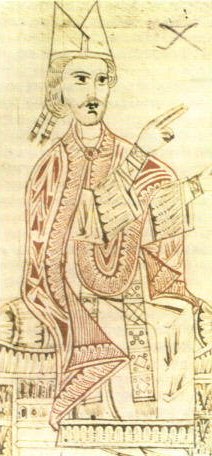
The 1074 call for Crusade by Pope Gregory VII

The 1095 speech by Pope Urban II delivered at Clermont Ferrand is well known. This speech aimed at arrousing the people to start a armed pilgrimage to deliver the Holy Land from the hands of the "pagans", that later became known as the First Crusade. Less well known is the speech with a similar purpose delivered in 1074, so about 20 years earlier, by Pope Gregory VII. In this speech the Pope suggested a military expedition to assist the Byzantine empire against the Seljuk Turks, following the defeat of the Byzantine army under Emperor Romanos IV Diogene by the Seljuk Turks at Manzikert in 1071. The very first call to crusade?

Pope Urban II call to crusade at Clermont, November 27, 1095

On November 27, 1095, Pope Urban II delivered his speech at Clermont Ferrand, aimed at arrousing the people to start an armed pilgrimage to deliver the Holy Land from the hands of the "pagans", a pilgirmage that later became known as the First Crusade. Of this speech several quite different versions have been delivered to our time by primary sources. Below are the version of Fulcher of Chartres and the one of Robert the Monk. 

An earlier founding date of the Templar Order reconstructed

In his book Hugues de Payns en Orient (2019), François Gilet investigates many primary and other sources, after which he reaches a detailed renewed reconstruction of the founding years of the Knights Templar. Confronting all of the chronicles allows him to develop a synthesis of the beginnings of the Temple Order and to move the genesis of their predecessors, today called "proto-Templars", to the year 1115.

The Templar cavalry charge

"The nearest thing that we have to a cavalry manual is the The Rule of the Templars, which in its present form seems to date from the thirteenth century. In several Rules such as 148 - 168 it lays down painstakingly detailed instructions for military behaviour including the delivery of a charge, and this within the framework of monastic discipline. What does the Rule say?

Templar trials retold in a convincing historical novel

The Templar trials of 1307-1314 are well documented by their records which were investigated by many scientists. There are, for instance, Malcolm Barber's classic The Trial of the Templars (2006), Helen Nicholson's The Proceedings Against the Templars in the Britisch Isles (2011), and more recently Alain Demurger's The Persecution of the Knights Templar: Scandal, Torture, Trial (2015/2020). 

However accurate and descriptive these monumental scientific studies are, they focus mainly on the scientific facts, as they should. They are not intended to elaborate on how the people of the day, the Templars concerned in the first place, experienced, felt about and dealt with what happened. For this, historical fiction may come to the rescue, as far as it is sufficiently researched and based on historical data. A good example of such a novel is Non Nobis by Hanny Alders.

The Templar Rule: its multiple origin and long development

The Primitive Rule of the Temple originated as result of the Troyes Council of January, 1129. During that council Hughes de Payens, the major founding member of the group of knights that from about 1119 lived in the former Al-Aqsa mosque on Table Montain, related an account of this group's foundation and history. What is known on the origin of the Rule and its development?

Martyrologies and legendaries: local roots of Medieval Templar communities

Among the books discovered in Templar churches (during the investigations following the Templar arrests of October 13, 1307; TN) were many psalters, legendaries, martyrologies, and antiphonals, but also books for different offices (officiaria) and breviaries. What is  their importance?