Showing posts with label pope. Show all posts

November 27, 1095 - Urban's call to crusade - the full text

On November 27, 1095, Pope Urban II delivered his speech at Clermont Ferrand, aimed at arrousing the people to start an armed pilgrimage to deliver the Holy Land from the hands of the "pagans", a pilgirmage that later became known as the First Crusade. Of this speech several quite different versions have been delivered to our time by primary sources. Below are the version of Fulcher of Chartres and the one of Robert the Monk. 

The Templar trials - more than one

It is often thought that the Templar trial in France, which commenced after the arrest of many Templars on October 13, 1307, was a single trial, carried out by either King Philip the Fair of France or the Pope. The latter being the one who had the sole jurisdiction on the Order of the Temple and its member. In reality, their were several investigations which succeeded each other in time, one secular and several ecclesiastical.

France, fall 1307: Templar arrests, interrogations, confessions and royal-papal power struggle

"On October 12, 1307 Jacques de Molay went to Paris specifically to attend the funeral of Catherine, wife of Charles de Valois, brother of the king. He resides, of course, within the Temple enclosure. It's a coincidence that he's here. Does this mean that he knows nothing of what is going on and that he has unconsciously thrown himself into the den of the wolf? 

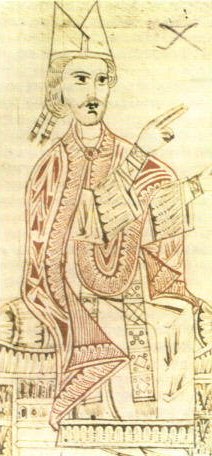
The 1074 call for Crusade by Pope Gregory VII

The 1095 speech by Pope Urban II delivered at Clermont Ferrand is well known. This speech aimed at arrousing the people to start a armed pilgrimage to deliver the Holy Land from the hands of the "pagans", that later became known as the First Crusade. Less well known is the speech with a similar purpose delivered in 1074, so about 20 years earlier, by Pope Gregory VII. In this speech the Pope suggested a military expedition to assist the Byzantine empire against the Seljuk Turks, following the defeat of the Byzantine army under Emperor Romanos IV Diogene by the Seljuk Turks at Manzikert in 1071. The very first call to crusade?

Pope Urban II call to crusade at Clermont, November 27, 1095

On November 27, 1095, Pope Urban II delivered his speech at Clermont Ferrand, aimed at arrousing the people to start an armed pilgrimage to deliver the Holy Land from the hands of the "pagans", a pilgirmage that later became known as the First Crusade. Of this speech several quite different versions have been delivered to our time by primary sources. Below are the version of Fulcher of Chartres and the one of Robert the Monk. 

The objective of the 1st Crusade - the changing Crusaders point of view

"
Crusaders in the East were for the time militia (to the Byzantine Emperor, TN) who were there to serve a purpose. The question of restituting the churches of the East to Rome was not in the crusader’s plans. This position changed drastically when (Emperor TN) Alexius abandoned the Crusaders in view of the impending Muslim backlash. 

Prologue of the Crusades - Jerusalem and the Seljuks

"
When the Muslim Seljuks, a Turkish steppe tribe, spectacularly defeated an army of the Byzantine Empire at the Battle of Manzikert in ancient Armenia in August 1071 CE, a series of events followed which would lead to centuries of East-West warfare couched in religious terms: the Crusades.

The Knights Templar: orthodox or heretics?

"
(...) Local (14th Century TN) chroniclers in England ‘supported the French version of the Templars’ heresy’, although King Edward II and his prelates did not. This raises the question of whether local chroniclers were aware of irregularities in the Templars’ religious beliefs that were not known to the higher authorities.

Papel bulls and the Knights Templar summarized

There are many important dates in the history the Middle Ages, but some notable ones were the issuance of the Papal Bulls and, in this instance, those issued for and against the medieval Knights Templar. A Papal Bull is a formal proclamation or order issued by the Pope and the use of "bull" is derived from the lead seal or "bulla" that is appended to the end of the order to authenticate it. Originally a Papal Bull was used for normal communications, but would evolve and used for formal and important occasions.

Knights Templar and Papal bulls: Militea Dei (1145)

Militea Dei’, the third of the papal bulls, issued by Pope Eugenius III in 1145, is very similar in both content and style to the one year older earlier ‘Milites templi’ (1144). The bull begins with praise for the knights’ efforts for the eastern church, drawing attention yet again to important military task the Order was saddled with. The bull moves on, much like the bull before it, to compel the clergy again to gather resources for the Templars.  

Celestine V - the 13th century abdicating pope

Pope Saint Celestine V (1215 – 19 May 1296), was born Pietro Angelerio to parents Angelo Angelerio and Maria Leone in a town called Sant'Angelo Limosano, in the Kingdom of Sicilia (Sicily). He showed an extraordinary disposition toward asceticism and solitude, which did not fit with his vocation as Pope. Consequently, he was one of the few Popes to resign.