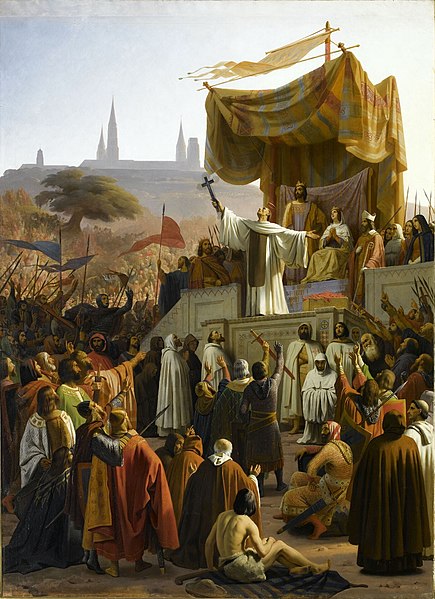
The Crusades, a solution to violence in Christianity

"The crusades were originally meant to redeem Europe from its violent nature, not to extend that violence. In this way, the crusades were intended to be a military pilgrimage of penance for the men who participated, a way of channeling the evil of their violence into a godly purpose. It was this idea that Bernard latched onto when he aided in the forming of the Templar order.

October 13, 1307

At dawn on Friday, 13 October 1307 (a date sometimes spuriously linked with the origin of the Friday the 13th superstition) King Philip IV ordered de Molay and scores of other French Templars to be simultaneously arrested.

The arrest warrant started with the phrase : "Dieu n'est pas content, nous avons des ennemis de la foi dans le Royaume" ["God is not pleased. We have enemies of the faith in the kingdom"].

Claims were made that during Templar admission ceremonies, recruits were forced to spit on the cross, deny Christ, and engage in indecent kissing. Brethren were also accused of worshiping idols, and the order was said to have encouraged homosexual practices. The Templars were charged with numerous other offences, financial corruption and fraud, and secrecy. Many of the accused confessed to these charges under torture, and these confessions, even though obtained under duress, caused a scandal in Paris.

Relenting to Phillip's demands, Pope Clement then issued the papal bull Pastoralis Praeeminentiae on 22 November 1307, which instructed all Christian monarchs in Europe to arrest all Templars and seize their assets. Pope Clement called for papal hearings to determine the Templars' guilt or innocence, and once freed of the Inquisitors' torture, many Templars recanted their confessions. Some had sufficient legal experience to defend themselves in the trials, but in 1310 Philip blocked this attempt, using the previously forced confessions to have dozens of Templars burned at the stake in Paris.

Source: wikipedia

Hugues de Payens' promotion tour - 1128-1129

Hugues de Payen, the first (grand)master of the Knights Templar, did in 1127 venture out on a fund-raising and recruitment trip to the West that lasted until mid 1129. What were the stages of his journey?

Muslim science and technology in de Middle Ages

The crusades brought the European elite in contact not only with muslim warfare technology, but also with muslim science. What did the "Franks" encounter?

Beauty in Simplicity - How Cistercian Architecture Shaped the Medieval World

Cistercian architecture is considered one of the most beautiful styles of medieval architecture. Cistercian architecture has made an important contribution to European civilization. Because of the pure style of the Cistercian monasteries and churches, they may be counted among the most beautiful relics of the Middle Ages. Cistercian institutions were primarily constructed in Romanesque and Gothic architectural styles during the Middle Ages; although later abbeys were also constructed in Renaissance and Baroque.

The Templars of Nieuwpoort and the Duvetorre

Little remains of the Templar presence in Nieuwpoort, a fishing town on the Belgian coast. A bequest from 1239, a mural uncovered behind a staircase in 1819, and a tower whose destruction is almost always misdated. What actually survives of this story once the errors are stripped away?

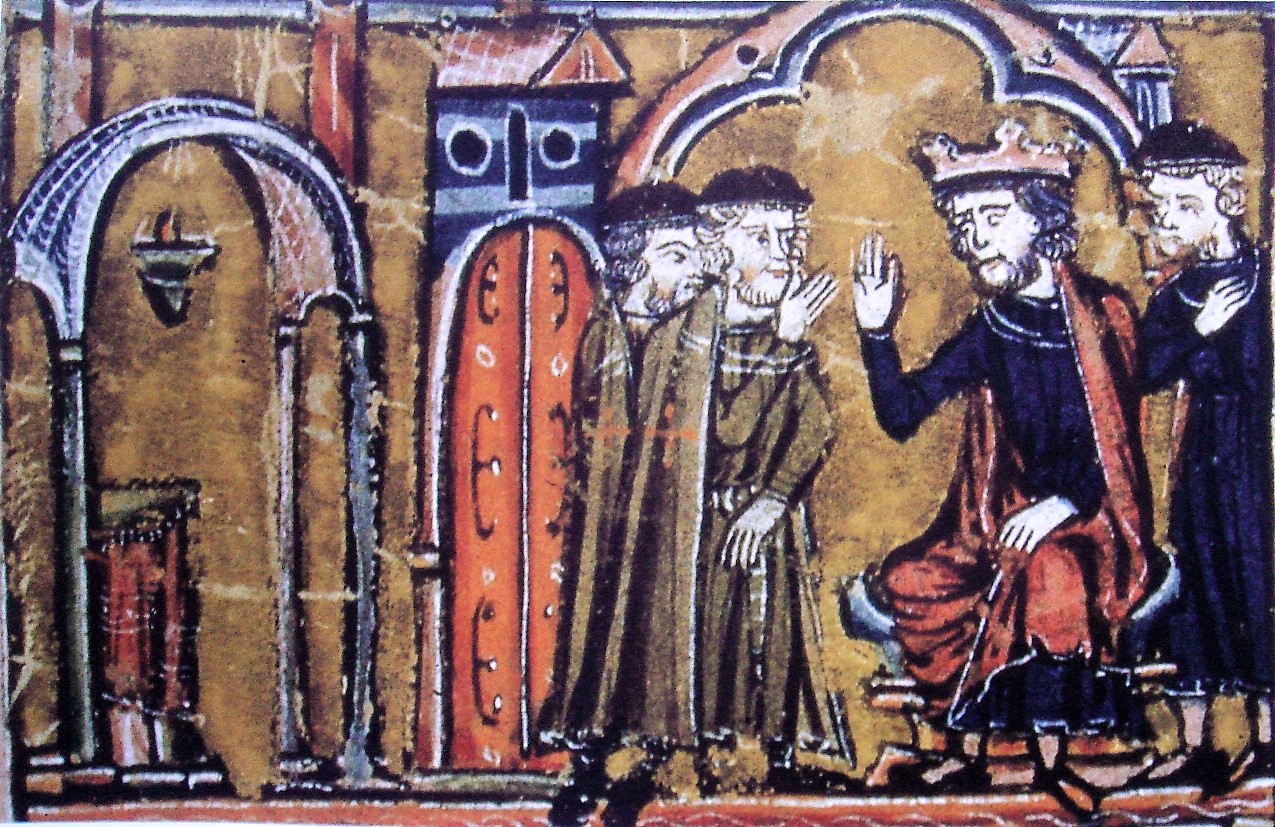
Political geography of the Low Countries 1000-1500

The second half of the medieval period, which may be termed the later Middle Ages, consists of the High Middle Ages (ca. 1000-1300) and Late Middle Ages (ca. 1300-1500). The primary powers of the later Middle Ages were the Holy Roman Empire, France, and England. Paris was the cultural and scholarly heart of the period.

The different profiles of Templars and Hospitallers

When were the Orders of Hospitallers and Templars born? What was their original purpose and how did this develop?  Medievalist Alain Demurger elaborates on the different profiles of the Templars and the Hospitallers.

The Templars amongst the other people of Outremer

When were the Orders of Hospitallers and Templars born? What was their original purpose and how did this develop. Medievalist Alain Demurger elaborates on the role of the soldiers of the Holy Land and their presence among the Crusaders, the Franks, the Christians of Outre Mer (the Orient) and the Muslims.