Jacques de Molay, the Last Templar Master - Youth and Reception

Jacques de Molay led the Templars to their end, yet his early life is poorly documented. One moment stands out: his reception at Beaune in 1265, which he described himself in 1307. What can we really know about the young man from the Free County of Burgundy?

Did Templars found Switzerland?

"The Warriors and the Bankers is an interesting discussion about the fate of the monastic and military order Knights Templar after October 13, 1307, the day of its supposed destruction orchestrated by the unpopular King of France, Philip IV. There is strong evidence that some French Templars escaped interrogation, torture and death in France and emigrated to Scotland where they were welcome to fight against the English. Is there also a Swiss connection?

Jacques de Vitry on the Templars - A Bishop at Acre Tells the Origin

First page of the Sermones vulgares by Jacques de Vitry, MS Riant 35, Houghton Library, Harvard University
Around 1220 the bishop of Acre wrote down how the Templars began, in a chapter that later writers kept repeating. He knew the brothers well, yet he wrote about events nearly a century earlier. What did he record, and how far can it be trusted?

Horses in the Temple

An important component amongst the equipment of a Templar knight were his horses and the equipment therefore. What were some other rules on Templar horses in peacetime?

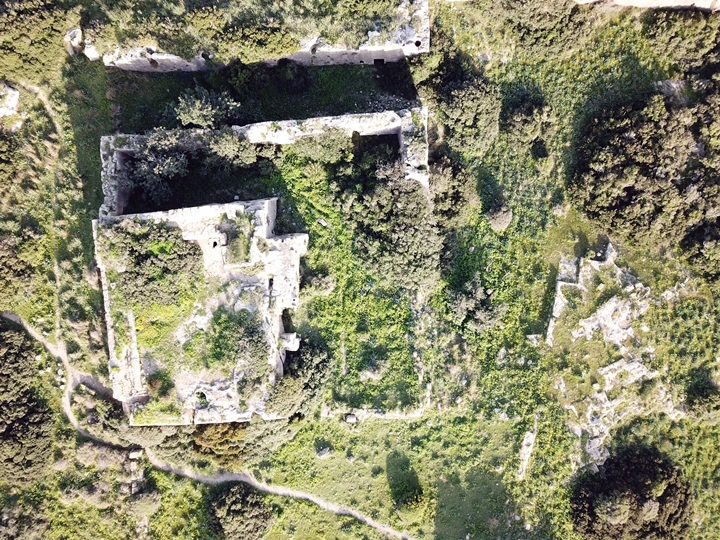
Location of the first Templar fortress revealed

In the Middle Ages the important coastal road from Acre and Haifa to Jerusalem ran through a narrow, probably man made passage in the sandstone ridge that runs parallel to the coast line directly to the east of Atlit peninsula. In primary sources this passage is called amongst others Petra Incisa ("carved rock") or Districtum/Destrictum, Destroit or Détroit ("strait") . The setting made the site an ideal location for robbers to ambush pilgrims and other travelers. As even King Baldwin I of Jerusalem discovered in 1103, when he was wounded by robbers in the area. What is the history of this remarkable place and what have the Templars to do with it?

Hugues de Champagne - A Count Who Became Brother Hugues

Silver denier of Count Hugues I of Champagne, struck at Troyes between 1093 and 1125
A count of Champagne gave up his lands, joined the new Order of the Temple in Jerusalem, and was still asked for advice by the men he had left behind. Two scholars date his departure a year apart and say little about his end. What do the documents allow us to say?

A New Jerusalem in Medieval Scandinavia - The Cross Relic of King Sigurd

Drawing by Gerhard Munthe (1899) of King Sigurd of Norway and King Baldwin I of Jerusalem during the Norwegian Crusade
In the early twelfth century Scandinavian rulers tried to bring Jerusalem north in relics and churches. King Sigurd of Norway came home from the Holy Land with a piece of the True Cross, and the sources disagree about what became of it. Where did it end up?

The Chinon Parchment of 1308 - Absolution not Acquittal

The Chinon Parchment of August 1308 in the Vatican Apostolic Archive, record of the absolution of the Templar leaders
In August 1308 three cardinals questioned Jacques de Molay and other Templar leaders at Chinon, and the record of those days survives on a large parchment in the Vatican. It is often described as proof that the Templars were cleared. What does a document of absolution actually show?

The relationship between Hugues de Payns and Bernard de Clairvaux

Often it is suggested that the Templar founder and first Master Hugues de Payns and the Templar's spiritual inspirer, the Cistercian abbot Bernard de Clairvaux must have been well acquainted at the onset of the start of the group that became known as the Templars (between 1114 and 1120). One of the arguments is that they both came from noble houses in the Champagne region, so must have known each others. And perhaps even worked together in the founding of the Templar Order. What are the facts?