The Council of Vienne: royal blackmail for Templar condamnation
The "Association Historique du Temple de Paris"
ASSOCIATION HISTORIQUE DU TEMPLE DE PARIS
40 Rue des Blancs Manteaux
75004 Paris
contact@templedeparis.fr
Tél . +33 1 30 70 00 52
In Paris, France an association exists called L'Association Historique du Temple de Paris. This is an independent association under French law that does not receive any subsidies. The objective of the association is:
- to establish in a general way the historical and heritage of the Temple district in Paris District (3rd Arrondissement) through the history of the Temple and of the life of the Knights Templar
- Combining efforts to disseminate publications by supporting writers in a joint action towards booksellers, local groups and the general public
- Organizing events such as exhibitions, lectures, tours, interventions in educational institutions, entertainment etc
- Establishing a strategy on communication, information and promotion,in partnership with local communities.
- Contributing to the cultural,historical and tourist development of the area of the Temple.
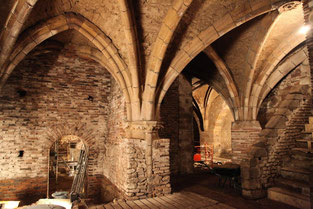
The website of the Association, which appears a bit outdated and undermanaged at the moment (May 2021), holds interesting information on events of all sorts, results of research undertaken at the Temple district as well as research carried out in the subterranean caves below the old town. The most important remains of Paris are to be found below ground, in the cellars of the houses that add up to many thousands. The research project is carried out by Danny Sandron, Director of the Centre André Chastel, in partnership with the Paris Department of History of Architecture and Archaeology, The Heritage Service and Inventory of the Regional Council of Ile de France and the Center of Parisian topography.
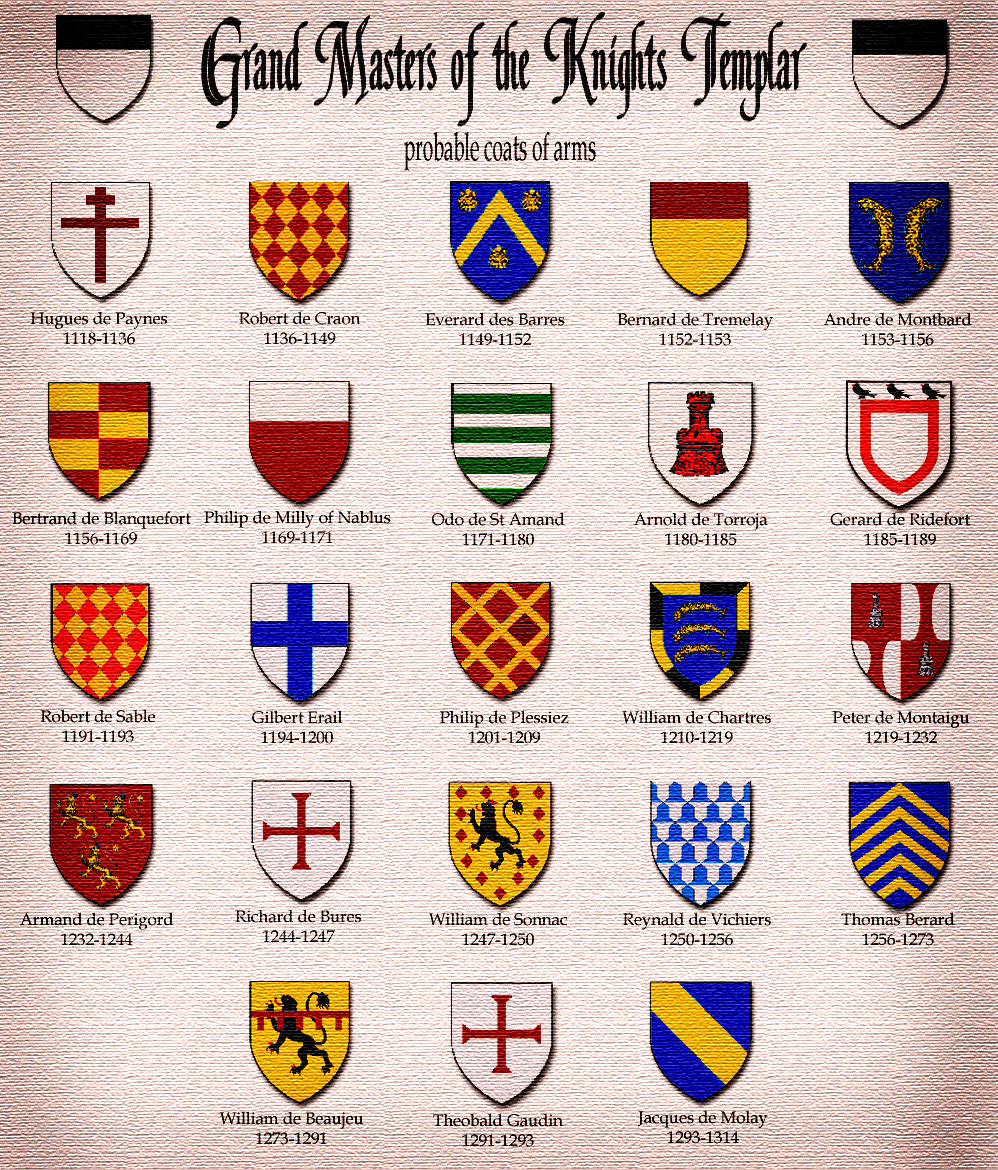
Both illustrations source
The first Order of Jerusalem: the Hospitaller Order of St John
Around 1050 the Amalfi merchant family De Pantaleon opened a hospital under the protection of St. John the Baptist in Jerusalem, close to the Holy Sepulchre. That is almost half a century before the first Crusade. An even earlier origin has been proposed. After the conquest of Jerusalem in 1099, this hospital developed further and the organisation was ultimately recognized as an independent Order by the Pope.
Beauchassin Templar House, Allier, France
The Allier Department does not house very many present day Templar sites, as can be seen on this map. However, one of the best preserved Templar houses, as yet usually overlooked, stands near the village of Saint Hilaire. TemplarsNow visited this Templar House, which is a private agricultural property and not to be visited, in the Summer of 2012 and was allowed to take some photograhs.
| aerial view of the Temple House at Beauchassin, Allier France. source google.com |
| view from the northwest (photo TemplarsNow 2012) |
![]() |
| driveway seen from the west (photo TemplarsNow 2012) |
The "Maison du Temple" of Beauchassin is located at the village of Saint-Hilaire, Département Allier, Arrondissement: Moulins, Canton: Bourbon-l'Archambault, municipality of Saint-Hilaire. Beauchassin is located close to and to the east of the "bourgh" of Saint Hilaire.
The name of the Templar settlement changed as follows: Bois-Chassain, Bost-Chassin or Bourg-Chassain and today Beauchassin. The site still shows traces of the Knights Templar, for instance in the stone tablet in the wall of the House (aerial photo above nr 1).
This tablet earlier was described to show a cross pattée, a type of cross which has arms narrow at the centre, and broader at the perimeter. This cross appears very early in medieval art, and became one of the characteristic signs of the Knights Templar. It is known, however, that in their early days Knights Templar wore a simple cross, as did all early crusaders. The present day cross at Beauchassin is not clearly a cross pattée as can be seen on the recent photographs below.
![]() | |
| cross pattée (?) above the main door of the house in the southeast facade of the House (photos TemplarsNow 2012) | cross pattée (?) in detail |
Some traces of the chapel still exist in the form of an ornamented doorway, shown on the pictures below. This doorway, set in the northwest facade of the building indicated nr 2 on the aerial photo above, nowadays leads into a agricultural building with a tin roof.
decorated doorway in northwest facade former chapel |
detail doorway (both pictures TemplarsNow 2012)
|
| |||
So there is not very much left of the former Templar origin of the site, although this origin is still documented by some striking details. Probably the Knights Hospitaller did take this house when the Temple Order was abolished in the early 14th century. However, only about 1 km to the westnorthwest, on the nearby D1 road, another (former) Hospitaller House is located, now aptly called La Croix Rouge (The Red Cross).
The color photographs were made and copy-righted by TemplarsNow. They may be re-used for non-commercial purposes, but only with full reference to this site and TemplarsNow. The above text is mainly a French-English translation by TemplarsNow of the text in www.templiers.net. The drawings are from templiers.net, which mentions as source thereof the municipal archives of Saint-Hilaire.
The Templar Order's birthdate pin-pointed on January, 1120
In his book The New Knighthood: A History of the Order of the Temple Malcolm Barber (1995) provides a detailed and by now classical reconstruction of the birth of the Templar Order.
The conclusions reached by Barber still stand, although an earlier date for the start of less formal activities by so-called proto-Templars has been presented recently (2019). This blog freely quotes some key passages from Barber, occasionally adding some details from other sources like Wikipedia.
The Masters of the Temple - a review worth reading
On his website Gordon Napier published an elabroate and apparently well researched review of the Masters of the Knights Templar through the ages. This review was an adapted version of A to Z of the Knights Templar by the same author. This blog quotes in full the introduction to this review with some minor adaptations.
Virtual visit to a Cistercian monastery
In an earlier contribution the basic plan of an 12th century Cistercian monastery was presented. This lay-out was applied in most abbeys. The present new contribution shows a YouTube 3D representation of the same. This allows for a virtual visit to an original Cistercian monastery.
"The Templar Revelation" reviewed by Theresa Welsh
Key quotes from the review by Theresa Welsh of The Templar Revelation: Secret Guardians Of The True Identity Of Christ
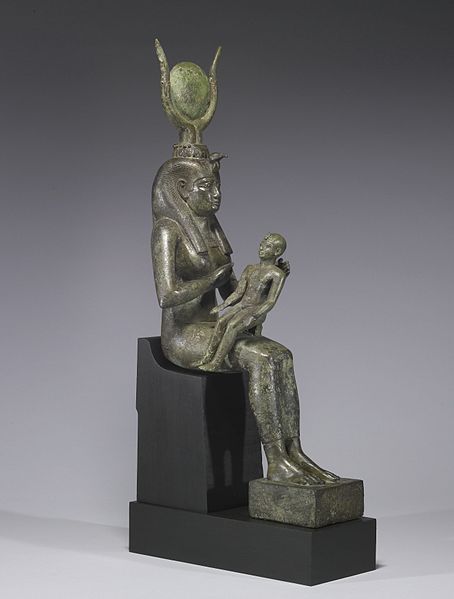
Picknett and Prince take the idea further and show that the roots of Christianity are in the Egyptian religion, especially the cult of Isis and Osiris. Osiris was killed on Friday and resurrected three days later by the power of his wife Isis, who then conceives their son, Horus. But even more parallels with Jesus can be found in the basic beliefs of the Isis religion, which emphasized repentance and confession. It was not Jesus who originally brought this message to the Jews, but another character who figures prominently in occult circles, John the Baptist. John is seen by the authors as a rival of Jesus who founded a substantial movement that continued to exist even though persecuted by Jews, Christians, and Moslems. John too took his ideas from Egypt, including immersion in water as a purification rite. (...)
Read the whole review at www.theseekerbooks.com; illustration: Eqyptian madonna: Isis with Horus child (source wikipedia)
Support TemplarsNow™ by becoming a Patron, tipping us or buying one of our Reliable Books
Knights Templar and Freemasonry today