
Showing posts with label origin. Show all posts
Showing posts with label origin. Show all posts
The Nablus Council, January 1120 - secular recognition of the Templar Order

Payen de Montdidier - co-founder of the Knights Templar

Payen (Paganus, Païen) de Montdidier was one of the founding members of the Knights Templar. He is one of the more obscure members of whom little is known. A quick scan in public sources showed that reliable data on Payen himself are very scarce indeed. At the same time, there is more than enough information to show the importance of his family and the contribution he made to the Templars. What are the facts?
The influence of the medieval Cistercians on the early Knights Templar

What was the extent of the influence of the Cistercians on the Templars?
Nine Templar founders - fact or fiction?

Noble support of the early Templars: funds, hands and land

The Holy Sepulchre, cradle of the Knights Templar

The early years of the Order of the Temple - a timeline

People behind the Knights Templar
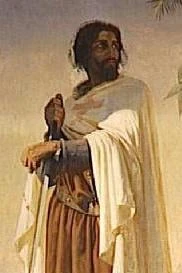
Usually the Knights Templar are referred to as if it was a a coherent body. This may have been the case in their later days. But in their early days, when the concept of knight-monks and the organisation were as such new, it seems more likely that they were a on-coherent group of individuals of different origins, mainly coming from early 12th century Francia.
Origin of the Cistercian Order: isolation and poverty
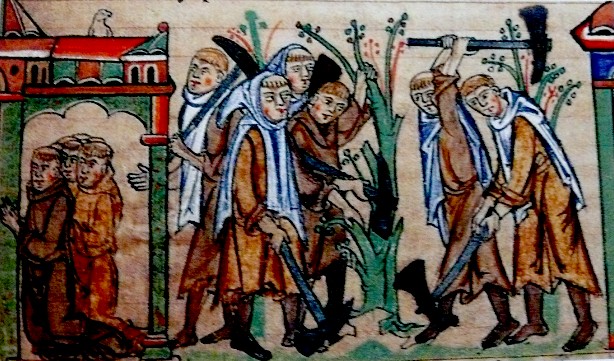
"The self-induced exclusion from the world discussed in the ‘Exordium Parvum’ is perhaps the first instance we see of the ideal of poverty, which became a part of the (Cistercian) Order’s mantra.
Knights Templar and Papal bulls: Milites Templi (1144)
.png)
The origin of The Knights Templar through early 12th century eyes

"Few scholars have approached the Knights Templar from the beginning, examining their creation in terms of where the order originates and why it was created. This makes this area largely unique and untouched, and the motivation of Bernard of Clairvaux’s (a major actor in the juvenil Cistercian Order) for helping form the order has been largely overlooked.
The Foundation of the Order of Knights Templar according to William of Tyre

The Cistercian link to the birth of the Knights Templar 1104-1129

The years 1104 till 1129 are key years of the history of the Knights Templar: the years of origin. What happened in that timespan? And what were the links with that other juvenile Order, the Cistercians?
The Templar Order's birthdate pin-pointed on January, 1120

In his book The New Knighthood: A History of the Order of the Temple Malcolm Barber (1995) provides a detailed and by now classical reconstruction of the birth of the Templar Order.
The conclusions reached by Barber still stand, although an earlier date for the start of less formal activities by so-called proto-Templars has been presented recently (2019). This blog freely quotes some key passages from Barber, occasionally adding some details from other sources like Wikipedia.
The origin of the Templars according to William of Tyre ca 1180

William of Tyre (c. 1130 – 29 September 1186) was a medieval prelate and chronicler. As archbishop of Tyre, he is sometimes known as William II to distinguish him from a predecessor, William of Malines. He grew up in Jerusalem at the height of the Kingdom of Jerusalem, which had been established in 1099 after the First Crusade, and he spent twenty years studying the liberal arts and canon law in the universities of Europe. How did William describe the Templar origin?
Champagne, the Templar cradle
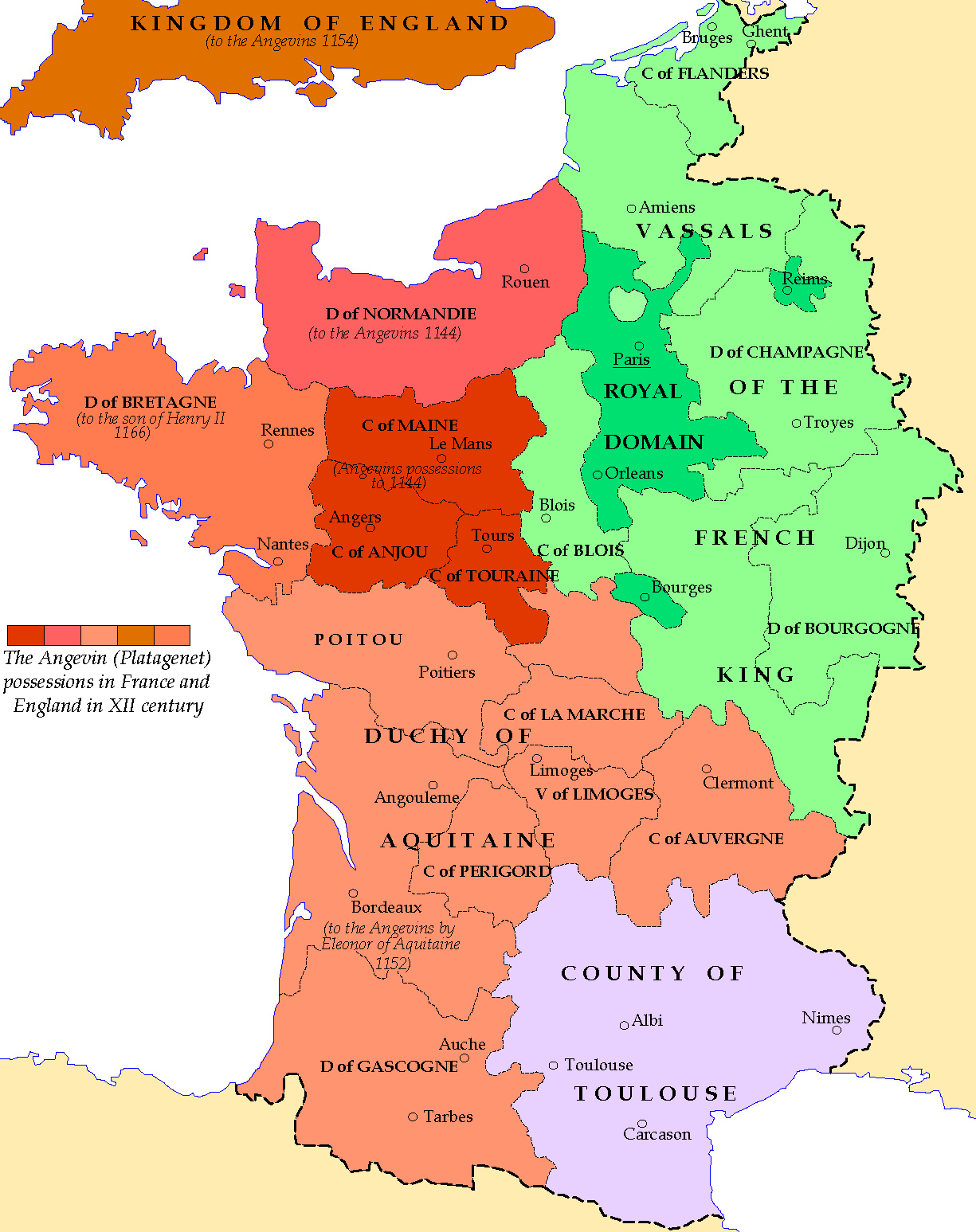
To understand the origin of the Knights Templar and the mechanisms that lead up to their birth, one should explore their place of origin. Standard historical belief places their origin in Jerusalem in the year 1118, 1119 or 1120. This, however, is not the case. The cradle of the Knights Templar stood at the court of the Count of Champagne in the French town of Troyes. The establishment of a fraternity at Jerusalem was just another step in a development that started years before.
Origin of the Knights Templar according to Addison (1842) - part 3

"The above rule having been confirmed by a Papal bull, Hugues de Payns proceeded to France, and from thence he came to England, and the following account is given of his arrival, in the Saxon chronicle.
"This same year, (A.D. 1128,) Hugh of the Temple came from Jerusalem to the king in Normandy, and the king received him with much honour, and gave him much treasure in gold and silver, and afterwards he sent him into England, and there he was well received by all good men, and all gave him treasure, and in Scotland also, and they sent in all a great sum in gold and silver by him to Jerusalem, and there went with him and after him so great a number as never before since the days of Pope Urban."
Grants of land, as well as of money, were at the same time made to Hugh de Payens and his brethren, some of which were shortly afterwards confirmed by King Stephen on his accession to the throne, (A.D. 1135.) Among these is a grant of the manor of Bistelesham made to the Templars by Count Robert de Ferrara, and a grant of the church of Langeforde in Bedfordshire made by Simon de Wahull, and Sibylla his wife, and Walter their son.
Hugh de Payens, before his departure, placed a Knight Templar at the head of the order in this country, who was called the Prior of the Temple, and was the procurator and vicegerent of the Master. It was his duty to manage the estates granted to the fraternity, and to transmit the revenues to Jerusalem. He was also delegated with the power of admitting members into the order, subject to the control and direction of the Master, and was to provide means of transport for such newly-admitted brethren to the far east, to enable them to fulfil the duties of their profession. As the houses of the Temple increased in number in England, sub-priors came to be appointed, and the superior of the order in this country was then called the Grand Prior, and afterwards Master of the Temple.
Many illustrious knights of the best families in Europe aspired to the habit and the vows, but however exalted their rank, they were not received within the bosom of the fraternity until they had proved themselves by their conduct worthy of such a fellowship. Thus, when Hugh d’Amboise, who had harassed and oppressed the people of Marmontier by unjust exactions, and had refused to submit to the judicial decision of the Count of Anjou, desired to enter the order, Hugh de Payens refused to admit him to the vows, until he had humbled himself, renounced his pretensions, and given perfect satisfaction to those whom he had injured. * The candidates, moreover, previous to their admission,
were required to make reparation and satisfaction for all damage done by them at any time to churches, and to public or private property.
An astonishing enthusiasm was excited throughout Christendom in behalf of the Templars; princes and nobles, sovereigns and their subjects, vied with each other in heaping gifts and benefits upon them, and scarce a will of importance was made without an article in it in their favour. Many illustrious persons on their deathbeds took the vows, that they might be buried in the habit of the order; and sovereigns, quitting the government of their kingdoms, enrolled themselves amongst the holy fraternity, and bequeathed even their dominions to the Master and the brethren of the Temple.
Thus, Raymond Berenger, Count of Barcelona and Provence, at a very advanced age, abdicating his throne, and shaking off the ensigns of royal authority, retired to the house of the Templars at Barcelona, and pronounced his vows (A.D. 1130) before brother Hugh de Rigauld, the Prior. His infirmities not allowing him to proceed in person to the chief house of the order at Jerusalem, he sent vast sums of money thither, and immuring himself in a small cell in the Temple at Barcelona, he there remained in the constant exercise of the religious duties of his profession until the day of his death. * At the same period, the Emperor Lothaire bestowed on the order a large portion of his patrimony of Supplinburg; and the year following, (A.D. 1131,) Alphonso the First, king of Navarre and Arragon, also styled Emperor of Spain, one of the greatest warriors of the age, by his will declared the Knights of the Temple his heirs and successors in the crowns of Navarre and Arragon, and a few hours before his death he caused this will to be ratified and signed by most of the barons of both kingdoms. The validity of this document, however, was disputed, and the claims of the Templars were successfully resisted by the nobles of Navarre; but in Arragon they obtained, by way of compromise, lands, and castles, and considerable dependencies, a portion of the customs and duties levied throughout the kingdom, and of the contributions raised from the Moors. *
To increase the enthusiasm in favour of the Templars, and still further to swell their ranks with the best and bravest of the European chivalry, St. Bernard, at the request of Hugh de Payens, † took up his powerful pen in their behalf. In a famous discourse "In praise of the New Chivalry," the holy abbot sets forth, in eloquent and enthusiastic terms, the spiritual advantages and blessings enjoyed by the military friars of the Temple over all other warriors. He draws a curious picture of the relative situations and circumstances of the secular soldiery and the soldiery of Christ, and shows how different in the sight of God are the bloodshed and slaughter perpetrated by the one, from that committed by the other.
St. Bernard then congratulates Jerusalem on the advent of the soldiers of Christ, and declares that the holy city will rejoice with a double joy in being rid of all her oppressors, the ungodly, the robbers, the blasphemers, murderers, perjurers, and adulterers; and in receiving her faithful defenders and sweet consolers, under the shadow of whose protection " Mount Zion shall rejoice, and the daughters of Judah sing for joy."
HUGH DE PAYENS, having now laid in Europe the foundations of the great monastic and military institution of the Temple, which was destined shortly to spread its ramifications to the remotest quarters of Christendom, returned to Palestine at the head of a valiant band of newly-elected Templars, drawn principally from England and France.
On their arrival at Jerusalem they were received with great distinction by the king, the clergy, and the barons of the Latin kingdom, a grand council was called together, at which Hugh de Payens assisted, and various warlike measures were undertaken for the extension and protection of the christian territories.
Hugh de Payens died, however, shortly after his return, and was succeeded (A.D. 1136) by the Lord Robert, surnamed the Burgundian, (son-in-law of Anselm, Archbishop of Canterbury,) who, after the death of his wife, had taken the vows and the habit of the Templars. * He was a valiant and skilful general, † but the utmost exertions of himself and his military monks were found insufficient to sustain the tottering empire of the Latin Christians."
source quotes: The History of the Knights Templar, by Charles G. Addison, [1842] ; illustration Bernard de Claivaux, souce Wikipedia.
Support TemplarsNow™ by becoming a Patron, tipping us or buying one of our Reliable Books
Origin of the Knights Templar according to Addison (1842) - part 2
.jpg)
The two most distinguished members of the fraternity were Hughues de Payns and Geoffrey de St. Aldemar, or St. Omer, two valiant soldiers of the cross, who had fought with great credit and renown at the siege of Jerusalem. Hugues de Payns was chosen by the knights to be the superior of the new religious and military society, by the title of "The Master of the Temple;" and he has, consequently, generally been called the founder of the order.
The name and reputation of the Knights Templars speedily spread throughout Europe, and various illustrious pilgrims from the far west aspired to become members of the holy fraternity. Among these was Falk, Count of Anjou, who joined the society as a married brother, (A.D. 1120,) and annually remitted the order thirty pounds of silver. Baldwin, king of Jerusalem, foreseeing that great advantages would accrue to the Latin kingdom by the increase of the power and numbers of these holy warriors, exerted himself to extend the order throughout all Christendom, so that he might, by means of so politic an institution, keep alive the holy enthusiasm of the west, and draw a constant succour from the bold and warlike races of Europe for the support of his christian throne and kingdom.
St. Bernard, the holy abbot of Clairvaux, had been a great admirer of the Templars. He wrote a letter to the Count of Champagne, on his entering the order, (A.D. 1123,) praising the act as one of eminent merit in the sight of God; and it was determined to enlist the all-powerful influence of this great ecclesiastic in favour of the fraternity. "By a vow of poverty and penance, by closing his eyes against the visible world, by the refusal of all ecclesiastical dignities, the Abbot of Clairvaux became the oracle of Europe, and the founder of one hundred and sixty convents. Princes and pontiffs trembled at the freedom of his apostolical censures: France, England, and Milan, consulted and obeyed his judgment in a schism of the church: the debt was repaid by the gratitude of Innocent the Second; and his successor, Eugenics the Third, was the friend and disciple of the holy St. Bernard." *
To this learned and devout prelate two knights templars were despatched with the following letter:
"Baldwin, by the grace of the Lord JESUS CHRIST, King of Jerusalem, and Prince of Antioch, to the venerable Father Bernard, Abbot of Clairvaux, health and regard.Soon after the above letter had been despatched to St. Bernard, Hugues de Payns himself proceeded to Rome, accompanied by Geoffrey de St. Aldemar, and four other brothers of the order, viz. Brother Payen de Montdidier, Brother Gorall, Brother Geoffrey Bisol, and Brother Archambauld de St. Amand. They were received with great honour and distinction by Pope Honorius, who warmly approved of the objects and designs of the holy fraternity. St. Bernard had, in the mean time, taken the affair greatly to heart; he negotiated with the Pope, the legate, and the bishops of France, and obtained the convocation of a great ecclesiastical council at Troyes, (A.D. 1128 which Hugues de Payns and his brethren were invited to attend.
"The Brothers of the Temple, whom the Lord hath deigned to raise up, and whom by an especial Providence he preserves for the defence of this kingdom, desiring to obtain from the Holy See the confirmation of their institution, and a rule for their particular guidance, we have determined to send to you the two knights, Andrew and Gondemar, men as much distinguished by their military exploits as by the splendour of their birth, to obtain from the Pope the approbation of their order, and to dispose his holiness to send succour and subsidies against the enemies of the faith, reunited in their design to destroy us, and to invade our christian territories.
"Well knowing the weight of your mediation with God and his vicar upon earth, as well as with the princes and powers of Europe, we have thought fit to confide to yon these two important matters, whose successful issue cannot be otherwise than most agreeable to ourselves. The statutes we ask of you should be so ordered and arranged as to be reconcilable with the tumult of the camp and the profession of arms; they must, in fact, be of such a nature as to obtain favour and popularity with the christian princes.
"Do you then so manage, that we may, through you, have the happiness of seeing this important affair brought to a successful issue, and address for us to heaven the incense of your prayers."
This council consisted of several archbishops, bishops, and abbots, among which last was St. Bernard himself. The rules to which the Templars had subjected themselves were there described by the master, and to the holy Abbot of Clairvaux was confided the task of revising and correcting these rules, and of framing a code of statutes fit and proper for the governance of the great religious and military fraternity of the Temple.
"THE RULE OF THE POOR FELLOW-SOLDIERS OF JESUS CHRIST AND OF THE TEMPLE OF SOLOMON," arranged by St. Bernard, and sanctioned by the Holy Fathers of the Council of Troyes, for the government and regulation of the monastic and military society of the Temple, is principally of a religious character, and of an austere and gloomy cast. It is divided into seventy-two heads or chapters, and is preceded by a short prologue, addressed "to all who disdain to follow after their own wills, and desire with purity of mind to fight for the most high and true king," exhorting
them to put on the armour of obedience, and to associate themselves together with piety and humility for the defence of the holy catholic church; and to employ a pure diligence, and a steady perseverance in the exercise of their sacred profession, so that they might share in the happy destiny reserved for the holy warriors who had given up their lives for Christ."
source quotes: The History of the Knights Templar, by Charles G. Addison, [1842]; illustration Hugues de Payns, source, Public Domain
Support TemplarsNow™ by becoming a Patron, tipping us or buying one of our Reliable Books
Hugues de Payns - cofounder of the Templars

Knights Templar - the first decade
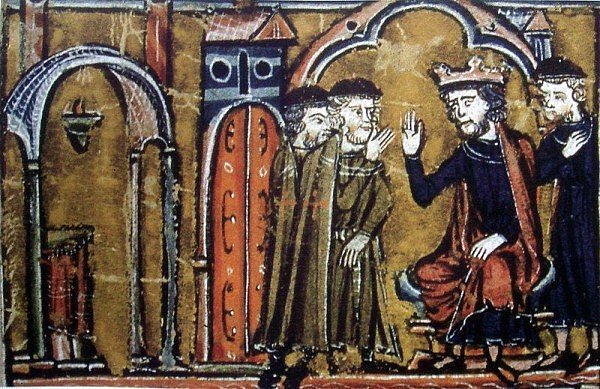
According to chroniclers of their early years, the Knights Templar were founded in 1118 by Hughes de Payen, a vassal of the Count of Champagne. In 1118 Baldwin I was King of Jerusalem. The older brother of the King, Godfroi de Bouillon, had been one of the leaders of the first Crusade (1096–1099) that had lead to the conquest of Jerusalem from the Muslims in 1099.
The group around Hugo de Payen, all related to each other by either blood or marriage, proposed themselves to King Baldwin I as an order of fighting monks, who would protect the roadways for pious pilgrims journeying to Jerusalem. They were given an entire wing of the royal palace as their headquarters, a wing that had been built upon the foundations of the Temple of Solomon. Thus they received their name: "the Knights of the Temple." The Templars made use of the numerous tunnels known to exist beneath Solomon's Stables on the Temple Mount. This use stands at the origin of many myths on treasure being searched for and found by the Templars at the temple site.
During the first nine years of their existence the Order admitted no new members. Furthermore, there is no evidence from contemporary chroniclers indicating that they engaged in the activities for which they were founded: the protection of pilgrims journeying to Jerusalem. Nevertheless they became famous throughout Europe as the selfless "Militia of Christ."
By 1127, most of the original Knights had returned to Europe. In 1128 Saint Bernard of Clairvaux, Andre de Montbard's uncle and abbott of the Cistercian monastery of Clairvaux, published on request of Hughes de Payen a pro-Templar tract entitled In Praise of the New Knighthood. In this tract Saint Bernard stresses the in those days new combination of monkhood and knighthood when he writes: "But when the one sees a man powerfully girding himself with both swords and nobly marking his belt, who would not consider it worthy of all wonder, the more so since it has been hitherto unknown? He is truly a fearless knight and secure on every side, for his soul is protected by the armor of faith just as his body is protected by armor of steel."
At the Saint Bernard-inspired Council of Troyes the same year, the Church officially recognized the Templars as a religious and military order dedicated to the defense of Christendom.
Support TemplarsNow™ by becoming a Patron, tipping us or buying one of our Reliable Books
Subscribe to:
Posts (Atom)