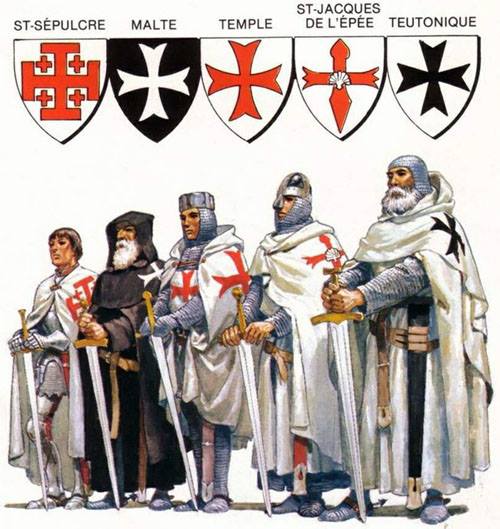
"The military religious orders were founded to fight on behalf of their fellow Christians, in defence of pilgrims and Christian territory. They fought alongside and supported the crusaders in the Holy Land. (...) In an era in which warriors who died fighting non-Christians were increasingly depicted as martyrs, it is not surprising that writers of the 1120s and 1130s associated the first knight-brothers with martyrdom. But as the Franks of the Holy Land met with division and defeat, how far did this imagery continue? Did outsiders continue to depict the brothers of the military orders in this way?
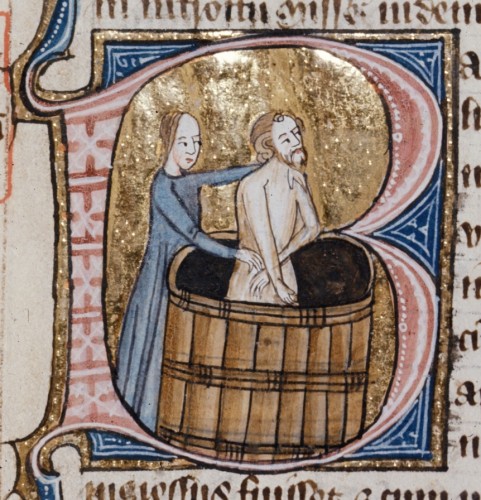
The founding of a Cistercian abbey, a good investment
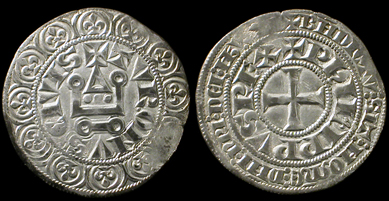
Financing the crusades - the role of the military orders
"Through the military orders of warrior-monks, the church provided directly for the defense of the Holy Land. The most important of these orders were the Knights of the Temple and the Brethren of the Hospital of St. John, although for a time the Teutonic Knights added their strength and resources to the common task.
How many Templars were there?
Is this a reasonable figure? (...) the estimated figure of 1,300 Templars in the East in the 1180s is too large. Perhaps there were only 300 brothers in total, in the whole of the East; that would mean that numbers more than halved between the 1180s and the early fourteenth century, but that would be reasonable after the losses of 1291-1302.
That is only the East: how many Templars were there overall? ... so far this suggests that there were no more than 1,500 Templars in Europe and Cyprus in 1307."
Text and illustration mainly from the blog by "Gawain's Mum" on gawainsmum.wordpress.com. Illustration shows Four Templar knights on the tomb of Don Felipe in the former Templar church of Santa Maria la Blanca de Villasirga, at Villacazar de irga (Palencia, Castile, Spain). Photo: Juan Fuguet Sans
Setting the stage for the Middle Ages - role of the Church
Setting the stage for the Middle Ages - daily life
"The sixth century marked the beginning of the Dark Ages in western Europe. While the Byzantine Empire generally prospered, despite its loss of territory, western Europe spent the six centuries after the death of Justinian in chaos, war, cultural degeneration, superstition, ignorance, and poverty. A harsh setting.
On Prophet Muhammad’s Covenants with Christians
"examines the roles that religious pluralism and civic rights played in Prophet Muhammad’s vision of a “Muslim nation”.
He demonstrates how Muhammad desired a pluralistic society in which citizenship and equal rights were granted to all people regardless of religious beliefs and practices. The Covenants of the Prophet Muhammad with the Christians of his time are used as a framework for analysis. These documents have received little attention in our time, but their messages are crucial in light of current debates about Muslim-Christian relations.
The article campaigns for reviving the egalitarian spirit of the Covenants by refocusing our understanding of the ummah as a site for religious freedom and civil rights. Ultimately, Considine argues that the Covenants of Prophet Muhammad with the Christians of his time can be used to develop a stronger narrative of democratic partnership between Muslims and Christians in the “Islamic world” and beyond."
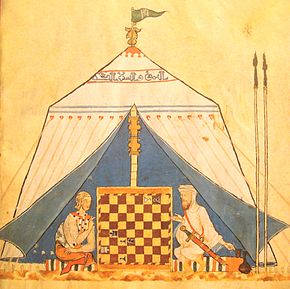
This blog contains the (slightly edited) entire Introduction to the following paper: Considine, C. Religious Pluralism and Civic Rights in a “Muslim Nation”: An Analysis of Prophet Muhammad’s Covenants with Christians. Religions 2016, 7, 1, which can be found at www.mdpi.com. Illustration: A Christian and a Muslim playing chess, illustration from the Book of Games of Alfonso X (c. 1285; from wikipedia.org, Public Domain.
Financing the Crusades - Papal support
"The privileges of popes and princes for the crusaders reveal the great importance of credit arrangements in financing the crusades.
Financing the military orders in medieval times
"Ultimately the financial support of the military orders and the confraternities derived from the alms and legacies of the faithful. By his gift to one of the orders any Christian could share in the great enterprise and in the spiritual rewards promised to crusaders.