Showing posts with label crusades. Show all posts

Jihad and Peace - Muslim Rulers and the Dilemma of Alliance with the Franks

The Crusades are commonly presented as a clash of civilisations driven by the ideology of jihad on one side and holy war on the other. Yet Muslim rulers in the Latin East concluded pragmatic alliances with their Christian enemies just as readily as the Franks did. When did such arrangements serve the faith and when did they betray it?

On German and East European participation in the Crusades

French nobility played a dominant part in the crusading movement. It was, after all, in 1195 at Clermont-Ferrand, France, that Pope Urban II rallied French secular and clerical nobles to engage in the first armed pilgrimage to free Jerusalem of 1196-1199. At the same time during the 13th centuries, German and Eastern European noble families also played a significant role in supporting the Crusades to the Holy Land. However, after the Fifth Crusade (1217–1221), the number of German nobles participating in such campaigns declined sharply and never recovered. What were important factors that led to this decline?

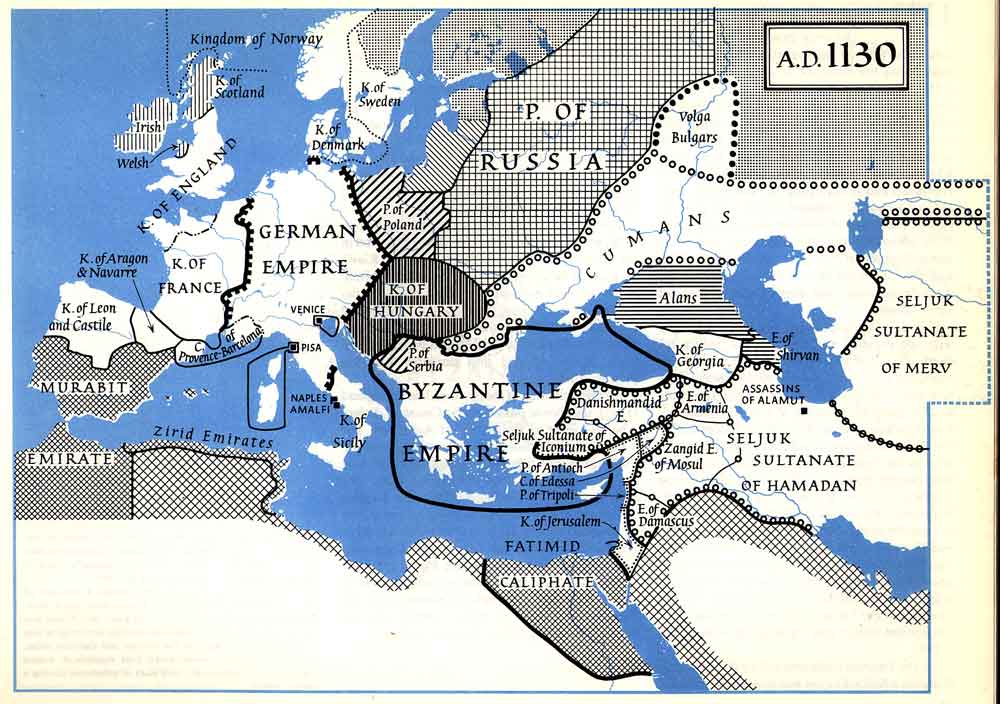
Crusading around 1150 - a "worldwide" coordinated effort

When thinking about crusading in the 12th century, one is usually inclined to consider first the Levant, and perhaps in second place present day Spain and Portugal. However, at the middle of the 12th century there were many more military theatres as well as coordinated efforts to achieve success in several places at the same time. An overview.

Reliable books on the Crusades

TemplarsNow is always looking to identify, promote and (re)distribute sources of reliable information on the Knights Templar and their time. Therefore this blog quotes the valuable list of "the 15 most important Books on the Crusades" prepared in 2017 by Andrew Holt PhD.

Dr Holt reported on his project to identify the "most important" books on the Crusades. He asked 34 leading medieval historians to provide their own preferential list. Their replies resulted in a list of some 150 titles. Analyzing this as to the number of times each title had been mentioned by the scolars, Dr Holt identified "the 15 most important Books on the Crusades". The titles are shown below, including the number of times each title was mentioned.


 Support TemplarsNow™ by becoming a Patrontipping us or buying one of our Reliable Books

Muslim-Christian alliance in early crusader times

Before and at the start of the First Crusade "An alliance existed between the Crusaders and the (muslim; TN) Fatimid rulers of Egypt (...) By the latter decades of the eleventh-century, these states (Byzantium and Fatimid Egypt; TN) had only known peace with each other in living memory, which is remarkable for the medieval world.

Financing the Crusades - general taxation

"A "first crude experiment" in compulsory almsgiving, the levy of 1166 begins the history of general taxation for financing the crusades.

Depictions of the Military Orders’ Martyrs in the Holy Land

"The military religious orders were founded to fight on behalf of their fellow Christians, in defence of pilgrims and Christian territory. They fought alongside and supported the crusaders in the Holy Land. (...)  In an era in which warriors who died fighting non-Christians were increasingly depicted as martyrs, it is not surprising that writers of the 1120s and 1130s associated the first knight-brothers with martyrdom. But as the Franks of the Holy Land met with division and defeat, how far did this imagery continue? Did outsiders continue to depict the brothers of the military orders in this way?

Financing the Crusades - Papal support

"The privileges of popes and princes for the crusaders reveal the great importance of credit arrangements in financing the crusades. 

Financing the Crusades - the "lesser men" and their partnerships

The communal organization of the "lesser men", the middle classes, revealed itself in their crusades, which took now the character of a huge partnership, now that of a trading company, and now that of a state enterprise.

Financing the Crusades - mortgages, loans and gifts

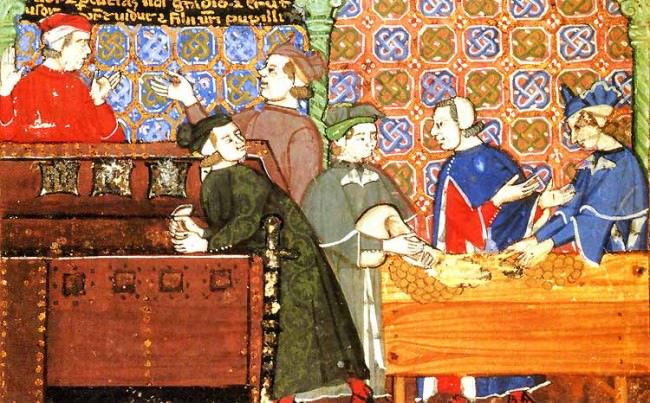
"(It were) loans by which crusaders perhaps most commonly financed their journeys. They borrowed from kings and princes, from monasteries and bishops, from lay lords and merchants, from whoever had money to lend.
 

The Templar's First Task - Highway Police in Peace Time

After the conquest of Jerusalem in 1099 the Kingdom of the Franks did not endure a perpetual state of emergency, as the chroniclers and many historians wanted us to believe. What was in those relatively quiet days the role of the Knights Templar?