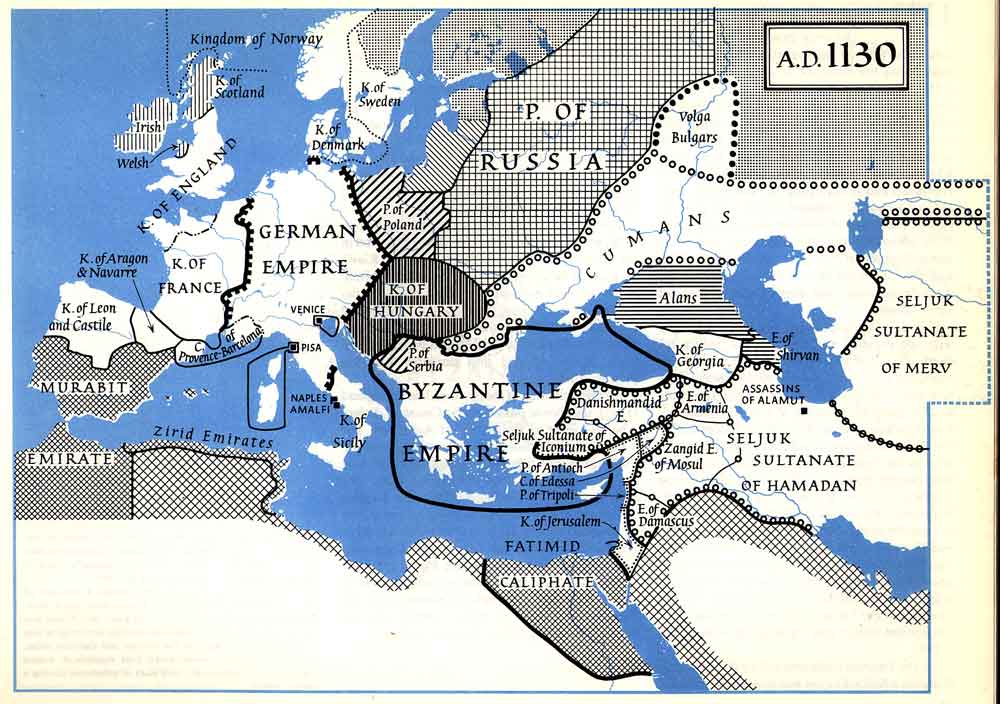
Muslim-Christian alliance in early crusader times

Development of ecclesiastical Templar legistlation

Noble legacies to the Knights Templar

Templar hospitals normal features in medieval France

Muslim-Christian coexistence during the crusading period

At the same time, recent scholarship (...) has uncovered that many Byzantine women who married into the Seljuk Dynasty maintained their Christian religious practices and passed them onto their children (future Seljuk sultans), many of whom were baptized at the Hagia Sophia, the main cathedral in Constantinople. A consciousness of conversion did develop in the medieval period, but a thirteenth-century Cilician Armenian law code suggests that conversions to Islam were reversible."
This blog quotes from "Diversity in the Medieval Middle East - Inclusions, Exclusions, Supporters, and Discontents" by Rachel Goshgarian, Chapter 9 in Lucia Volk's The Middle East in the World: An Introduction (Foundations in Global Studies) (Routledge, 2015) on www.academia.edu; source illustration the Comnenus mosaics in the Hagia Sophia, Istanbul, Public Domain, source Wikipedia
Support TemplarsNow™ by becoming a Patron, tipping us or buying one of our Reliable Books
Dhimma - diversity and multiculturalism in medieval Islam

11th century Benedictine translations of Islamic manuscripts

Medieval Anatolian architectural hybridities

The Seljuks were the first Turkish Muslim entity to become established in the region (the Byzantine defeat by the Seljuk Turks took place 1071; TN). They were followed by many other similar Turkish and Persian-speaking principalities, which existed either as subservient to the Seljuks or in direct competition with them.
At the same time, the Armenians established their own principality and, later, kingdom in the region. And after the First Crusade, a Latin Crusader state was established around Antioch. This was followed by the entrance of the Mongols into the region. Those Mongols who had converted to Islam (and were known as the Ilkhanids) extended their territory into Anatolia in the mid-thirteenth century, forming the largest contiguous land empire in the history of humankind.
As all of these political entities established themselves in Anatolia, they supported the construction of churches, mosques, religious schools (medreses, or ma-drassas), dervish lodges ( zaviyes), and caravansaries (inns), completely transforming the physical landscape both of urban areas and the hinterland. These physical structures, in turn, altered the cultural life of the region, by providing spaces within which individuals could gather to pray, study, or participate in the development of mystical religious practices.
The architectural programs funded in Anatolia—by a range of individuals associated with myriad local principalities—altered the urban and rural landscapes of the region. On a purely aesthetic level, these architectural programs are material evidence of the kind of hybridity that was common in late medieval Anatolia. Many of the masons and architects constructing new “Islamic” buildings (e.g., mosques, madrassas, and dervish lodges) were members of indigenous Christian populations. As a result, while many of the buildings and their functions were new, the physical appearance of much of the early Islamic architecture of Anatolia looks very similar to what is traditionally considered the Armenian, Byzantine, and Georgian (i.e., Christian) architecture of the region.
This blog quotes a portion of "Diversity in the Medieval Middle East - Inclusions, Exclusions, Supporters, and Discontents" by Rachel Oshgarian which can be found here. Illustration: Ruins of the Cathedral of Ani and the church of Redeemer in Ani, an ancient capital of Armenia in the 10th century; photo by Antonio, source Wikipedia Commons
Support TemplarsNow™ by becoming a Patron, tipping us or buying one of our Reliable Books
Medieval Benedictine anti-islam manuscripts by Peter of Cluny

Peter the Venerable (c. 1092 – 25 December 1156) was between 1122 and 1156 the 8th abbot of the Benedictine abbey of Cluny. (...) His greatest achievement is his contribution to the reappraisal of the Church’s relations with the religion of Islam (by translating Islamic manuscripts such as the Qur'an; TN).
Subscribe to:
Posts (Atom)