
Templar and Hospitaller cooperation in the 12th century Orient

The Templar navy - the early phase

Development of the novelty of the right of clerical self-defense 1120-1176

Nablus 1120 - the medieval ban of clergy bearing arms lifted

"Between 1049 and 1095, no fewer than thirteen councils and synods had damned clerical armsbearing. At nine of these thirteen assemblies, three different popes and six papal legates presided. The reforming papacy seemingly could not have been clearer on this issue. After that there is almost nothing in the decrees of the seven so-called ecumenical or general councils held between 1123 and 1312. (...)
Muslim-Christian alliance in early crusader times
Development of ecclesiastical Templar legistlation

Noble legacies to the Knights Templar

Templar hospitals normal features in medieval France

Muslim-Christian coexistence during the crusading period

At the same time, recent scholarship (...) has uncovered that many Byzantine women who married into the Seljuk Dynasty maintained their Christian religious practices and passed them onto their children (future Seljuk sultans), many of whom were baptized at the Hagia Sophia, the main cathedral in Constantinople. A consciousness of conversion did develop in the medieval period, but a thirteenth-century Cilician Armenian law code suggests that conversions to Islam were reversible."
This blog quotes from "Diversity in the Medieval Middle East - Inclusions, Exclusions, Supporters, and Discontents" by Rachel Goshgarian, Chapter 9 in Lucia Volk's The Middle East in the World: An Introduction (Foundations in Global Studies) (Routledge, 2015) on www.academia.edu; source illustration the Comnenus mosaics in the Hagia Sophia, Istanbul, Public Domain, source Wikipedia
Support TemplarsNow™ by becoming a Patron, tipping us or buying one of our Reliable Books
Dhimma - diversity and multiculturalism in medieval Islam

11th century Benedictine translations of Islamic manuscripts

Medieval Anatolian architectural hybridities

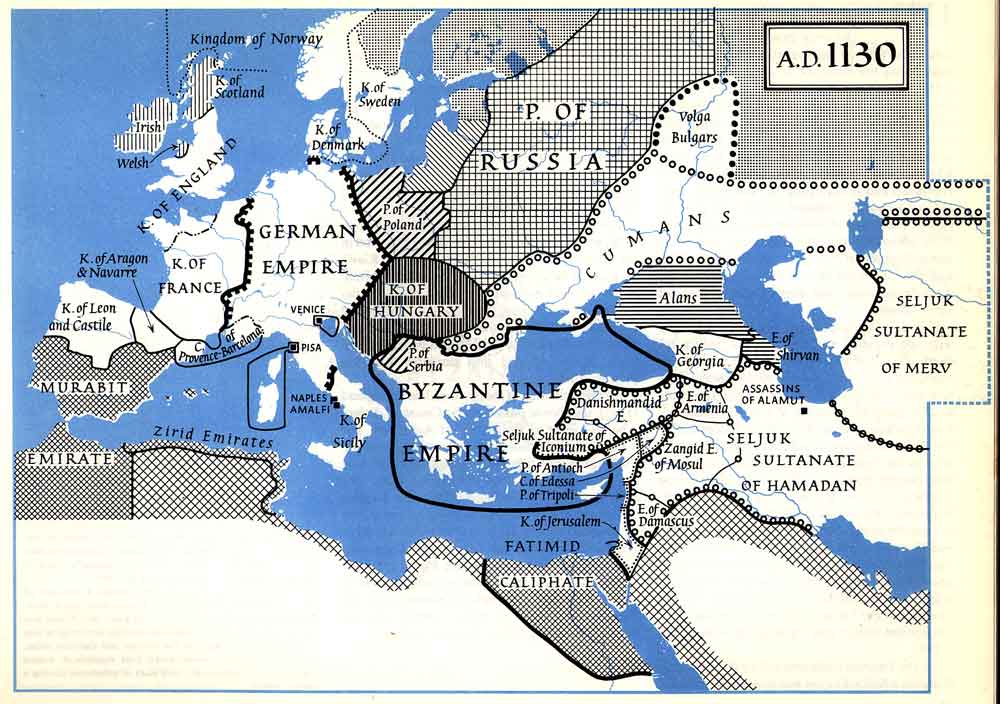
The Seljuks were the first Turkish Muslim entity to become established in the region (the Byzantine defeat by the Seljuk Turks took place 1071; TN). They were followed by many other similar Turkish and Persian-speaking principalities, which existed either as subservient to the Seljuks or in direct competition with them.
At the same time, the Armenians established their own principality and, later, kingdom in the region. And after the First Crusade, a Latin Crusader state was established around Antioch. This was followed by the entrance of the Mongols into the region. Those Mongols who had converted to Islam (and were known as the Ilkhanids) extended their territory into Anatolia in the mid-thirteenth century, forming the largest contiguous land empire in the history of humankind.
As all of these political entities established themselves in Anatolia, they supported the construction of churches, mosques, religious schools (medreses, or ma-drassas), dervish lodges ( zaviyes), and caravansaries (inns), completely transforming the physical landscape both of urban areas and the hinterland. These physical structures, in turn, altered the cultural life of the region, by providing spaces within which individuals could gather to pray, study, or participate in the development of mystical religious practices.
The architectural programs funded in Anatolia—by a range of individuals associated with myriad local principalities—altered the urban and rural landscapes of the region. On a purely aesthetic level, these architectural programs are material evidence of the kind of hybridity that was common in late medieval Anatolia. Many of the masons and architects constructing new “Islamic” buildings (e.g., mosques, madrassas, and dervish lodges) were members of indigenous Christian populations. As a result, while many of the buildings and their functions were new, the physical appearance of much of the early Islamic architecture of Anatolia looks very similar to what is traditionally considered the Armenian, Byzantine, and Georgian (i.e., Christian) architecture of the region.
This blog quotes a portion of "Diversity in the Medieval Middle East - Inclusions, Exclusions, Supporters, and Discontents" by Rachel Oshgarian which can be found here. Illustration: Ruins of the Cathedral of Ani and the church of Redeemer in Ani, an ancient capital of Armenia in the 10th century; photo by Antonio, source Wikipedia Commons
Support TemplarsNow™ by becoming a Patron, tipping us or buying one of our Reliable Books
Medieval Benedictine anti-islam manuscripts by Peter of Cluny

Peter the Venerable (c. 1092 – 25 December 1156) was between 1122 and 1156 the 8th abbot of the Benedictine abbey of Cluny. (...) His greatest achievement is his contribution to the reappraisal of the Church’s relations with the religion of Islam (by translating Islamic manuscripts such as the Qur'an; TN).
Medieval Frankish society well in touch with the Holy Land

"In this seminal work, Ronnie Ellenblum, a professor at the Hebrew University of Jerusalem, challenges the assumptions of prominent 20th-century scholars concerning the composition and character of crusader settlement and society. (...) Ellenblum’s research enabled the “reconstruction” of entire villages ― property by property ― identifying in the process the origins and vocations of many of the inhabitants. This survey turned up roughly 200 Frankish settlements, most of which had never been heard of before either because the settlements themselves had since been abandoned, ruined and overgrown, or because their Frankish origins were hidden behind modern Arabic names and more recent construction.
One of Ellenblum’s chief theses is that: “The Franks…were very successful settlers and were not only fighters and builders of fortifications. The migrants who settled in the Kingdom of Jerusalem established a network of well-developed settlements…includ[ing] the construction of developed castra [towns], of ‘rural burgi,’ and monasteries, of castles that served as centers for seigniorial estates, of smaller castles, manor houses, farmhouses, unfortified villages, parochial systems etc.”
Even more important, Ellenblum proves beyond a shadow of a doubt that the claim of earlier historians such as Prawer and Smail “that the Franks were completely unaware of what went on in their fields (save when it came to collecting their share of the crops), and had no contact with the local inhabitants, is not based on written or archeological sources and is certainly not accurate.” (Emphasis added.) (...) This book makes all previous conclusions about Frankish society obsolete, and any depiction of Frankish Palestine that does not take Ellenblum’s conclusions into account can be dismissed as inaccurate."
Frankish Rural Settlement in the Latin Kingdom of Jerusalem (Cambridge OCR Advanced Sciences)

Support TemplarsNow™ by becoming a Patron, tipping us or buying one of our Reliable Books
Cluny Abbey - 10th century start of restoring spiritual independence

Christian pilgrimage to the Holy Land during the first centuries AD

11th Century Benedictine participation in the Toledo "School" of Translators

8th to 10th century pilgrimage to the Holy Land

Early christian pilgrimage and relics

11th Century Cluniac promotion of pilgrimage to the Holy Land

In 910 count William I of Aquitaine founded the abbey of Cluny, and in a few decades Cluny became the center of a vast ecclesiastical nexus, closely controlled by the mother-house, which itself owed obedience to the papacy alone. The Cluniacs took an interest in pilgrimage, and soon organized the journey to the Spanish shrines.
10th Centrury worldy dominance over the church

Crusade on the 11th century Mediterranean Sea

Co-habitation of church and state in early 11th century France

Journeys of Relics in Tenth to Twelfth Century Northern France and Flanders

Subscribe to:
Posts (Atom)